New preprint announcement
Yttrium Superhydrides Revisited: Advanced Experimental and Theoretical Studies of YH6, YH9 and YH10
We are pleased to announce the submission of our latest preprint to arXiv, titled Yttrium Superhydrides Revisited: Advanced Experimental and Theoretical Studies of YH6, YH9 and YH10.
The yttrium–hydrogen system is second only to lanthanum–hydrogen in its importance for superhydride research, and it carries one of the field’s most famous promises: cubic Fm3̄m-YH10 was predicted almost a decade ago to superconduct at up to 326 K, comfortably above room temperature. Yet YH10 has never been synthesized. What experiments do produce, reliably, are the sodalite-like clathrates Im3̄m-YH6 and P63/mmc-YH9. Despite a decade of work on these benchmark materials, several basic properties of the Y–H system have remained uncharacterized, and the persistent 20 K gap between calculated and measured Tc values has never been resolved within a single, consistent framework.
This preprint is a joint effort with several experimental groups. Our partners in Beijing, Shanghai, Moscow and Dresden synthesized the samples in diamond anvil cells and ran the full measurement campaign between 140 and 213 GPa, covering contact transport, contactless radio-frequency susceptibility, and pulsed magnetic fields up to 60 T. The measurements reveal remarkably narrow superconducting transitions, with ΔTc ≈ 2–5 K for YH6 (Tc = 218–226 K) and YH9 (Tc = 235–243 K). For the best YH6 sample the width approaches the fundamental limit set by thermal fluctuations, which the Ginzburg–Levanyuk number places at 0.6–1.5 K. Pulsed fields up to 60 T give a linear upper critical field with dBc2/dT = −0.52 T/K, pronounced broadening of the transition above 30 T, and essentially no normal-state magnetoresistance.
A highlight of the experimental efforts is the first radio-frequency AC susceptibility study of an yttrium superhydride. Using Pt/Ta Lenz-lens microcoils sputtered directly onto the diamond anvils, our colleagues detect the superconducting transition of YH6 at 221 K through high-frequency field screening in a fully contactless geometry, closing a gap that had already been filled for H3S, CeH9 and the lanthanum polyhydrides.
A second thread of the work addresses a claim that has caused considerable confusion in the community. Following the published and subsequently retracted report of a 262 K yttrium hydride synthesized with a palladium catalyst, the experimental team tested palladium and aluminum systematically. Hydrides made from arc-melted Pnma-Y3Pd show no superconductivity above 120 K; samples prepared with a sputtered Pd thin film superconduct only below 20 K; and a 1:1 Y–Al alloy hydrogenated at 180 GPa shows no transition anywhere between 78 and 290 K. Both elements act as strong suppressors of high-temperature superconductivity in yttrium hydrides, and neither offers a route to enhancement.
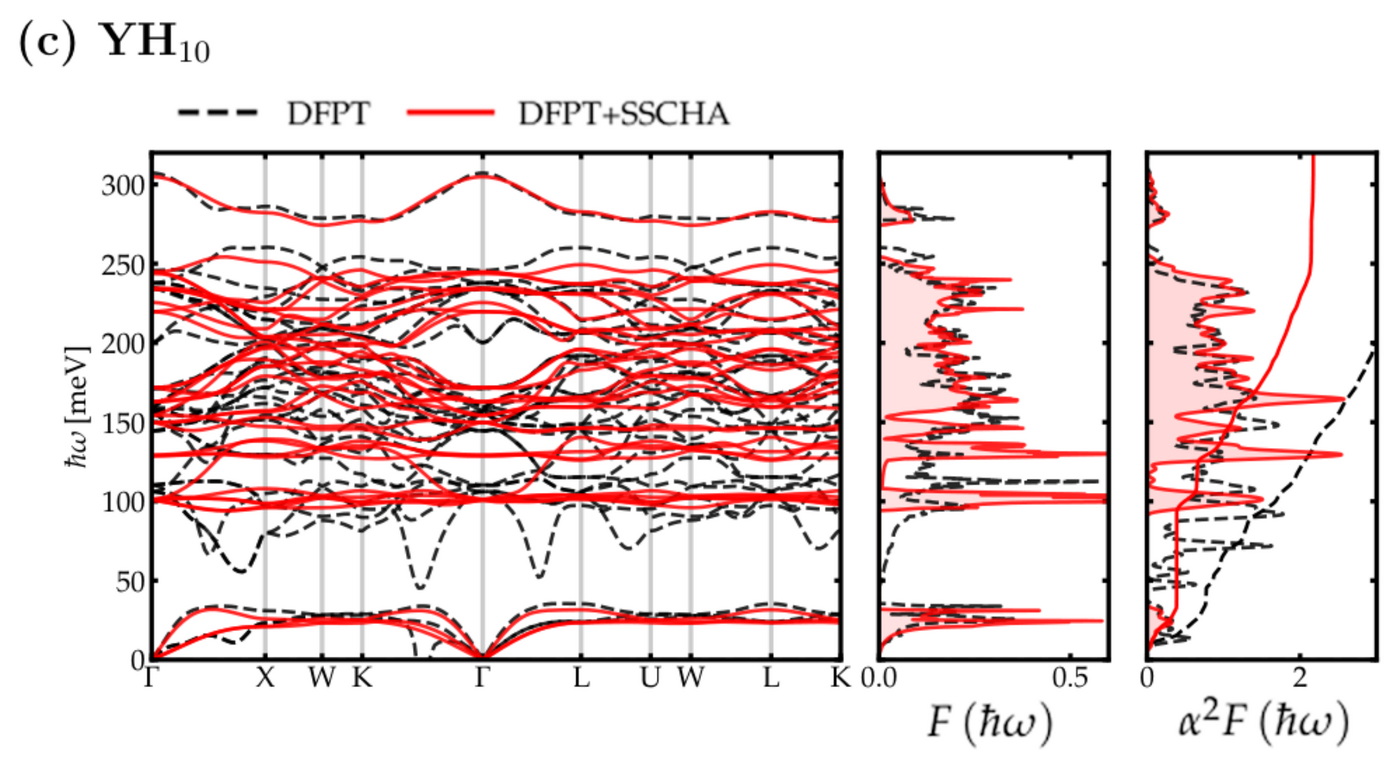
Our contribution treats all three phases within one methodological framework, using density-functional perturbation theory together with the stochastic self-consistent harmonic approximation and full-bandwidth Migdal–Eliashberg calculations as implemented in our IsoME code, with Ryosuke Akashi adding an independent cross-check from superconducting density-functional theory, which gets by without any empirical Coulomb parameter. Quantum anharmonic effects turn out to be decisive. They stabilize YH9 at 200 GPa and YH10 at 250 GPa by hardening soft harmonic instabilities, they open a clean phonon gap between the yttrium and hydrogen manifolds, and they cut the coupling strength dramatically: λ falls from 6.50 to 2.20 in YH9 and from 3.33 to 2.17 in YH10, while ωlog rises correspondingly. Together with the appropriate rescaling of the Coulomb pseudopotential and the full-bandwidth treatment of the Eliashberg equations, this brings theory and experiment into excellent agreement. For YH9, the discrepancy in Tc shrinks from 16% to about 3%.
We applied the same machinery to YH10 as well. The harmonic calculation already yields 283 K rather than the 310–326 K reported earlier, and including anharmonicity brings Tc down to roughly 260–270 K, with superconducting DFT giving an even lower 221 K. Room-temperature superconductivity in this binary yttrium superhydride is therefore strongly disfavored, even in a phase nobody has managed to make. The search for a genuine room-temperature superconductor will have to look elsewhere.
We’re excited to share this work and look forward to the community’s feedback!
Check out the preprint arXiv:2608.11428.