Two new preprints
First-principles framework for ultrafast dynamics and light-induced superconductivity in conventional superconductors
We are delighted to announce the simultaneous submission of two closely linked preprints to arXiv, representing a major joint effort between our group at Graz University of Technology and our collaborators at MIT’s Research Laboratory of Electronics.
The first, Ultrafast dynamics and light-induced superconductivity from first principles, develops a predictive ab initio framework for the nonequilibrium response of optically driven superconductors. The second, Fast Real-Axis Eliashberg Calculations: Full-bandwidth solutions beyond the constant density of states approximation, provides the critical methodological engine that makes the first possible. Together, these works open a new chapter in the first-principles description of conventional superconductors driven far from equilibrium.
The methodological foundation: solving Migdal-Eliashberg theory directly on the real-frequency axis
Nearly all experimentally accessible properties of a superconductor, such as tunneling spectra, optical conductivity, and quasiparticle lifetimes, are real-frequency quantities. Yet the Migdal-Eliashberg equations, the gold standard for ab initio strong-coupling superconductivity, are almost universally solved on the imaginary-frequency (Matsubara) axis and then analytically continued to real frequencies. Analytic continuation is an ill-conditioned inverse problem that amplifies numerical errors, blurs spectral features, and becomes increasingly unstable at low temperatures, precisely where the physics is most interesting.
In arXiv:2603.18199, we bypass this bottleneck entirely. We present a practical and efficient scheme to solve the finite-temperature Migdal-Eliashberg equations directly on the real-frequency axis, while retaining the full energy dependence of the electronic density of states. Most existing real-axis implementations sacrifice this in favour of a constant density of states approximation. A key algorithmic contribution is a reformulation of the integral kernel K(ω,ω’) that reduces the computational cost from the conventional O(N2) to O(N), enabling high-resolution solutions to converge in milliseconds (in the constant density of states case) to minutes (with the full variable density of states) on a standard laptop.
We demonstrate the importance of going beyond the constant density of states approximation on H3S, the archetypal high-Tc hydride. H3S hosts a prominent van Hove singularity near the Fermi level that induces strong particle-hole asymmetry. Our full-bandwidth real-axis solution yields a zero-temperature superconducting gap of 2Δ ≈ 60 meV, in close agreement with recent tunneling measurements, while the constant density of states approximation overshoots at 75 meV. The direct real-frequency solutions also display fine spectral structure inherited from α2F(ω) that is irretrievably lost in analytically continued results, and they remain numerically stable across the entire temperature range from millikelvin to above Tc.
The physics: ultrafast dynamics and photo-induced superconductivity from first principles
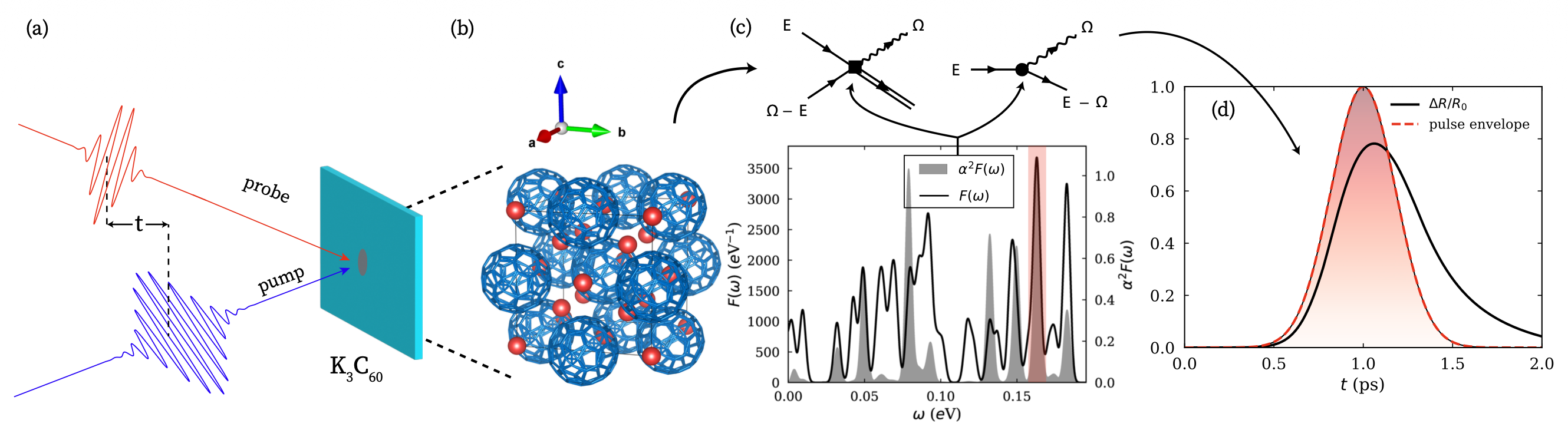
Armed with this fast real-axis solver, arXiv:2603.18182 constructs the first fully self-consistent, first-principles framework for the nonequilibrium response of conventional superconductors to ultrafast optical excitation. The approach couples a set of kinetic equations for the quasiparticle distribution f(E,t) and the phonon distribution n(ω,t), an extension of the Chang-Scalapino equations to the strong-coupling regime, solved self-consistently with the Migdal-Eliashberg equations on the real-frequency axis. All material-specific inputs, including the Eliashberg spectral function α2F(ω) and the phonon density of states, are computed from density functional (perturbation) theory. The optical response of the driven film is then obtained from the time-dependent complex conductivity via a Kubo formula, and the Maxwell equations are solved to yield the differential reflectance ΔR/R0 and differential transmission −ΔT/T0 for direct comparison with pump-probe experiments.
We validate the framework quantitatively on two conventional superconductors that could hardly be more different: Pb at ambient pressure, with its soft phonon spectrum and modest coupling, and LaH10 at 165 GPa, where superconductivity is driven by stiff hydrogen vibrations and reaches Tc ≈ 250 K. For Pb, the temperature-dependent amplitude and recovery time of −ΔT/T0 agree quantitatively with experiments. For LaH10, the model captures the multi-timescale relaxation dynamics and the onset of a phonon bottleneck at higher fluences. This cross-material consistency across vastly different phonon energy scales and coupling strengths confirms the robustness of the approach.
Explaining and predicting photo-induced superconductivity
With validation in hand, we turn to the problem that has captivated the community for over a decade: photo-induced superconductivity. In the alkali-doped fulleride K3C60, mid-infrared pump pulses at 170 meV have been reported to induce signatures of superconductivity at temperatures far above the equilibrium Tc,0 ≈ 20 K, but the underlying mechanism has remained controversial.
Our calculations, using electron-phonon inputs computed with FHI-aims, reproduce a prominent peak in α2F(ω) at 170 meV, precisely the energy targeted by the pump in the experiments. Replicating the experimental conditions, we obtain a transient photo-induced gap Δ0(t) > 0 at temperatures well above Tc,0, persisting briefly after the pump is switched off. This photo-induced state emerges entirely within the framework of conventional electron-phonon-mediated superconductivity. Resonant excitation of quasiparticles to energies matching the peak in α2F(ω) depletes the gap-edge population and enhances pairing, in close analogy to the long-known enhancement of superconductivity under microwave irradiation. The mechanism is therefore not exotic; it is a natural consequence of the phonon spectrum.
Crucially, this analysis reveals a general design principle. Materials with prominent high-frequency structure in α2F(ω) are candidate systems for photo-induced superconductivity. Guided by this insight, we identify calcium-intercalated graphite, CaC6, as a promising new candidate and predict a photo-induced gap response comparable to that of K3C60 when pumped resonantly at its characteristic phonon frequency, a prediction that is directly testable with existing ultrafast spectroscopy equipment.
These two works are deeply intertwined. The fast real-axis Eliashberg solver is not merely a convenience for the nonequilibrium calculations; it is a necessity. Updating the full Migdal-Eliashberg solution at each time step of the kinetic equations would be prohibitive with traditional imaginary-axis methods that require analytic continuation. Our linear-scaling real-axis approach reduces this to a tractable computation, transforming a formally intractable problem into a practical tool for materials prediction.
We believe these results establish a new baseline for the theoretical study of driven superconductors, and we look forward to seeing how the community applies and extends this framework, particularly toward the long-standing goal of light-enhanced or even room-temperature superconductivity.
Check out the preprints at arXiv:2603.18182 and arXiv:2603.18199.