New preprint announcement
Anharmonic lattice dynamics and superconductivity in strained bulk and surface niobium
We are pleased to announce the submission of our latest preprint to arXiv, titled Anharmonic lattice dynamics and superconductivity in strained bulk and surface niobium.
Niobium is the workhorse of superconducting technology. From radio-frequency cavities in particle accelerators to superconducting qubits and single-photon detectors, Nb and its compounds underpin much of our quantum technological infrastructure. Yet a surprisingly basic question remains open: how exactly do strain and crystallographic surface orientation shape Tc at the microscopic level? Experiments on thin films and surfaces hint at strong sensitivity to these factors, but a unified first-principles picture has been lacking.
In this work, we tackle both questions using state-of-the-art ab initio methods combined with isotropic Migdal–Eliashberg theory. For bulk Nb, we show that tensile strain is a remarkably effective lever: by systematically expanding the lattice up to ~6%, phonon softening drives a dramatic increase in the electron–phonon coupling constant, pushing Tc from 9.5 K at equilibrium all the way to 14.5 K—a more than 50% enhancement. The functional derivative δTc/δα2F(ω) reveals why: tensile strain progressively shifts phonon spectral weight toward the optimal pairing energy scale, making the coupling not just stronger but spectrally better targeted.
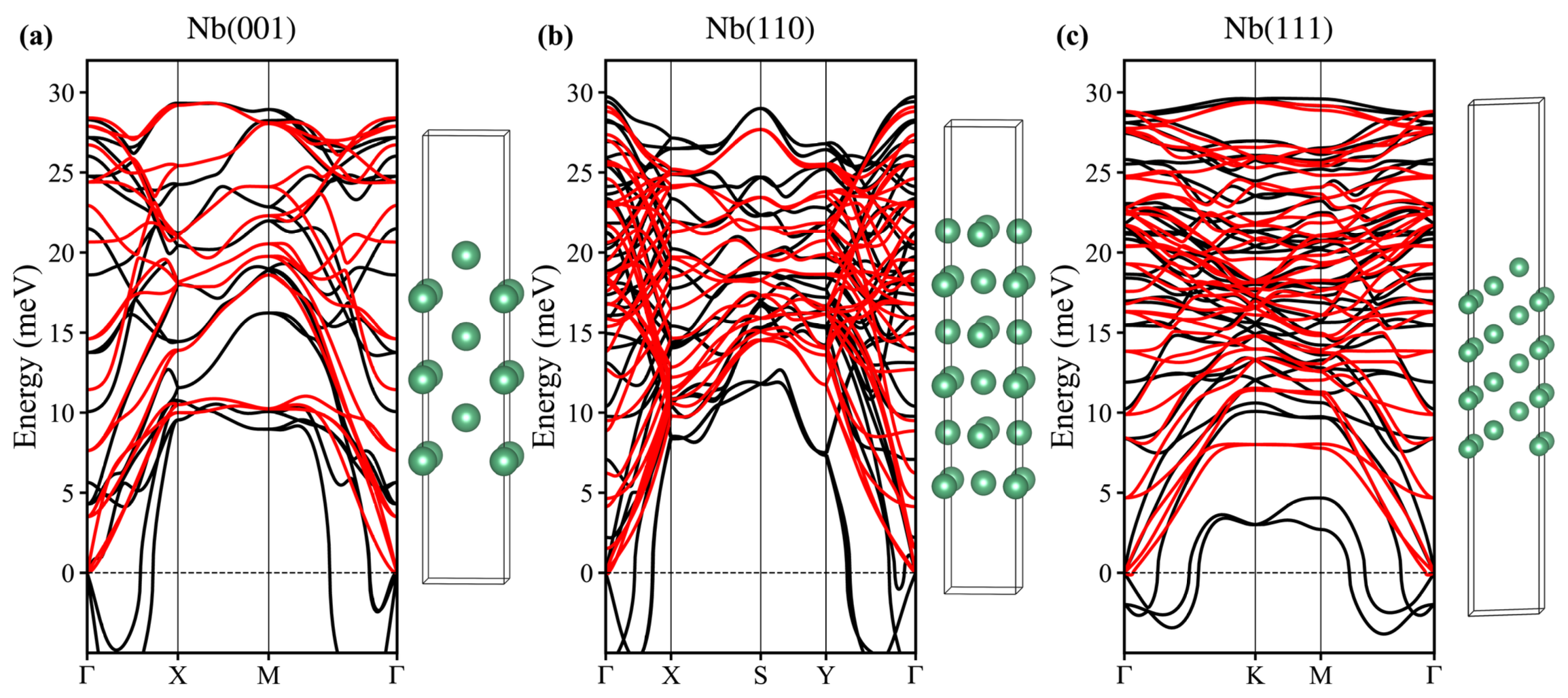
The surface perspective is even richer—and computationally more demanding. For the three low-index terminations Nb(001), Nb(110), and Nb(111), harmonic phonon calculations immediately run into trouble: all three slabs exhibit imaginary modes, signaling that anharmonic lattice effects are not optional but essential. To treat these efficiently, we trained Nb-specific machine-learning interatomic potentials on first-principles bulk and slab configurations and used them to accelerate stochastic self-consistent harmonic approximation (SSCHA) calculations. The anharmonically renormalized phonon spectra are fully stabilized and reveal a clear orientation dependence of superconductivity: Nb(001) exhibits the strongest electron–phonon coupling (λ = 1.1) and a Tc of 10.0 K, while Nb(110) and Nb(111) show progressively reduced pairing strength down to 6.0 K. This constitutes a concrete, testable prediction for surface-sensitive probes such as tunneling spectroscopy on well-characterized single-crystal Nb surfaces.
Across both the strain and surface studies, the spectral distribution of the electron–phonon coupling turns out to matter as much as its total strength, a message with direct implications for engineering superconducting properties in Nb-based devices, where surface preparation, crystallographic quality, and residual strain are all experimental handles.
We’re excited to share this work and look forward to the community’s feedback!
Check out the preprint arXiv:2606.02730.