New preprint announcement
EGQCA Code: automated high-throughput thermodynamic modeling of solid solutions
We are pleased to announce the submission of our latest preprint to arXiv, titled EGQCA Code: automated high-throughput thermodynamic modeling of solid solutions.
Most materials that end up in real technology are not perfect crystals but solid solutions: steels and superalloys, the Nb–Ti wire wound into every MRI magnet, the InxGa1-xN layers in blue LEDs, and the high-entropy alloys that are reshaping metallurgy. Their properties are tuned by composition, yet describing them from first principles remains awkward. In a disordered alloy the constituents are scattered randomly over the lattice, so a faithful description needs large supercells, and the usual shortcuts either average the disorder away in a mean-field picture (virtual crystal or coherent potential approximation) or commit to a single representative cell at each composition.
The extended generalized quasichemical approximation (EGQCA), which we introduced for superconducting alloys two years ago, takes a different route. The alloy is represented as an ensemble of symmetry-inequivalent clusters whose occurrence probabilities follow from minimizing the mixing Gibbs free energy, with the mixing enthalpy, the configurational entropy and the vibrational free energy treated on the same footing. Once the cluster energies (and, optionally, their volumes and phonon densities of states) are known, every thermodynamic quantity and any cluster-resolved property, from lattice parameters and band gaps to the density of states at the Fermi level or Tc, follows as a weighted average at arbitrary composition, temperature and pressure, at essentially no extra cost. Since then we have used the method for systems as different as SrTi1-xVxO3, quasicrystal approximants derived from Al13Os4, and ternary hydrides under pressure.
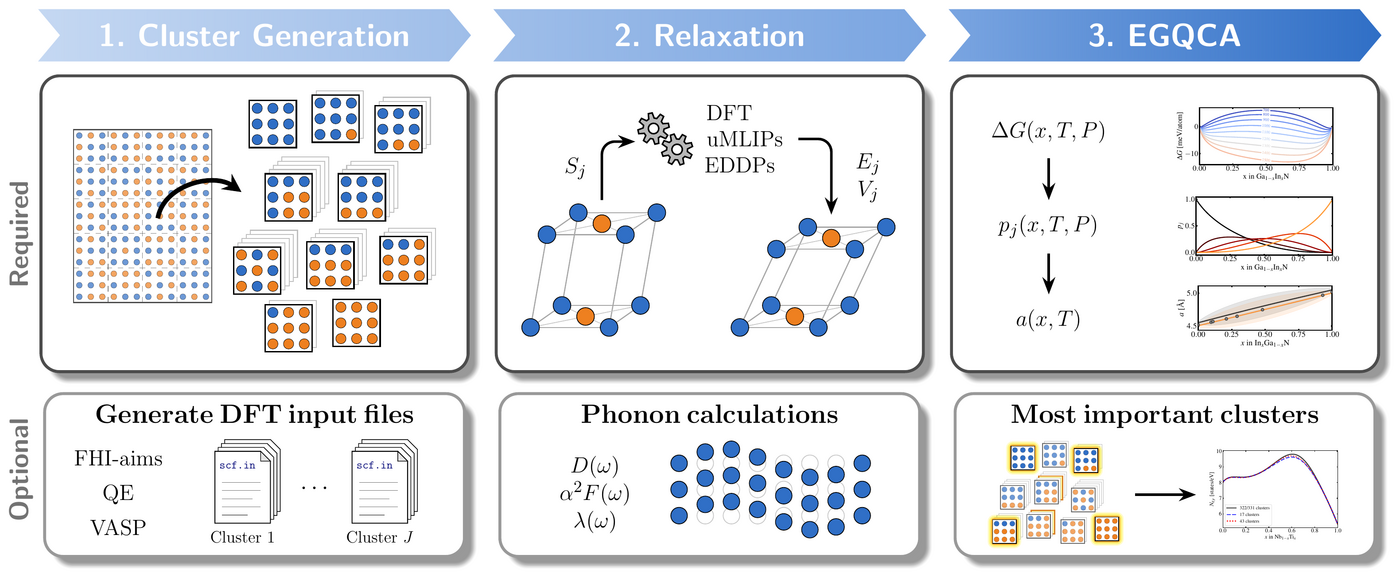
With this preprint we make EGQCA available to everyone as the open-source Python package egqca. It automates the complete workflow: it generates all inequivalent clusters for a given supercell, writes the input files for FHI-aims, Quantum ESPRESSO or VASP, or relaxes the clusters directly with universal machine-learned interatomic potentials (uMLIPs), and then carries out the full thermodynamic assessment, including miscibility gaps and composition-dependent property averages, in a few lines of Python. Along the way we also revisited the configurational entropy itself and now use a site counting that properly accounts for overlapping supercell clusters, a generalization of the Bethe–Peierls entropy.
Swapping DFT for uMLIPs is where things get fast. Testing MACE-MPA-0-medium, MatterSim-5M and PET-OMATPES-L, we computed the lattice parameters of nine intermetallic solid solutions in a single high-throughput sweep and obtain a mean relative error below 1% against experiment. For InxGa1-xN, MatterSim reproduces the DFT miscibility gap with the same critical composition, xc = 0.39, and a critical temperature within about 6%, in 74 seconds on a single CPU core instead of more than 1800 core-hours of DFT, a saving of nearly five orders of magnitude. For Nb1-xVx, the uMLIPs even capture how lattice vibrations lower the critical temperature of the miscibility gap. The benchmarks also show where caution is needed: for the layered van der Waals alloy (Bi1-xSbx)2Se3, the universal models disagree with experiment and with each other, which is exactly the warning sign to look out for. There, a dedicated ephemeral data-derived potential (EDDP), trained on dispersion-corrected DFT data together with our colleagues in Cambridge, brings the volumes back in line with experiment.
The second bottleneck is properties that are expensive to compute for every cluster, such as electron-phonon coupling. For these we introduce a cluster-selection algorithm that ranks clusters by their thermodynamic weight across the composition range and keeps only the most relevant ones. For Nb1-xTix at 300 GPa, just 17 of the 331 clusters reproduce the compositional dependence of the density of states at the Fermi level, and a uMLIP already picks out 15 of those 17, so the selection can be made before running a single DFT calculation. This is what makes demanding quantities such as the superconducting Tc tractable across the entire composition range.
Together, these developments turn EGQCA into a practical tool for high-throughput screening of disordered materials, and the next steps, extending the formalism to multicomponent alloys and competing crystal structures, point toward complete phase diagrams computed at a fraction of the usual cost. The code is available on GitHub and on PyPI (pip install egqca), with documentation at egqca.github.io/egqca and all data on Zenodo. The work was led by Dominik Spath and Pedro N. Ferreira, together with collaborators in Cambridge, Rome and São Paulo.
We’re excited to share this work and look forward to the community’s feedback!
Check out the preprint arXiv:2611.34551.