New preprint announcement
Superconducting gap in covalent bismuth dihydride BiH2 under extreme conditions
We are pleased to announce the submission of our latest preprint to arXiv, titled Superconducting gap in covalent bismuth dihydride BiH2 under extreme conditions.
Hydrides under megabar pressure have given us the highest transition temperatures ever measured, but almost everything we know about them comes from a single observable: the resistance drop that marks Tc. The superconducting gap Δ, which is what actually characterizes the pairing state, has remained nearly inaccessible. A diamond anvil cell leaves no room for conventional spectroscopy, the samples are a few micrometres across, and pressure gradients and phase coexistence blur whatever signal survives. The one direct measurement so far, the Ta/Ta2O5/H3S tunnel junction of Du and co-workers, required a purpose-built tunnel barrier fabricated inside the cell. Complementary probes that work in an ordinary four-probe geometry would be very welcome.
The temperature dependence of the critical current is such a probe. In the self-field limit Jc is set by the magnetic penetration depth, and hence by the superfluid density and the gap, so that within the Talantsev-Tallon framework Jc ∝ λ-3(T) and the low-temperature shape of Jc(T) discriminates between nodeless, nodal and multiscale gap structures. The catch is that in a high-Tc hydride the currents required to suppress superconductivity near zero temperature run to several amperes, which simply burns the leads in a DAC. Our experimental partners get around this with short rectangular pulses of 10-50 μs separated by millisecond intervals, which keeps the time-averaged Joule heating manageable while allowing peak currents up to 160 mA, enough to follow Jc(T) all the way down to 2 K.
The material of choice is covalent bismuth dihydride, synthesized at 157-176 GPa by laser-heating bismuth in an ammonia borane medium and identified by synchrotron X-ray diffraction as P21/m-BiH2. It superconducts between 58 and 70 K, which is modest by hydride standards, but its upper critical field of only 11-17 T is what makes it useful here: that is a factor of ten below the Pauli limit of about 119 T, it corresponds to a coherence length above 45 Å, and it puts μ0Hc2(0)/Tc at 0.2 T/K, well under the values of cubic LaH10 or CaH6. The low field scale traces back to the unusually high Fermi velocity of roughly 11×105 m/s carried by the bismuth-dominated bands, three to five times larger than in hydrides where hydrogen dominates at the Fermi level. Low fields and a correspondingly accessible critical current are exactly the conditions the pulsed method needs.
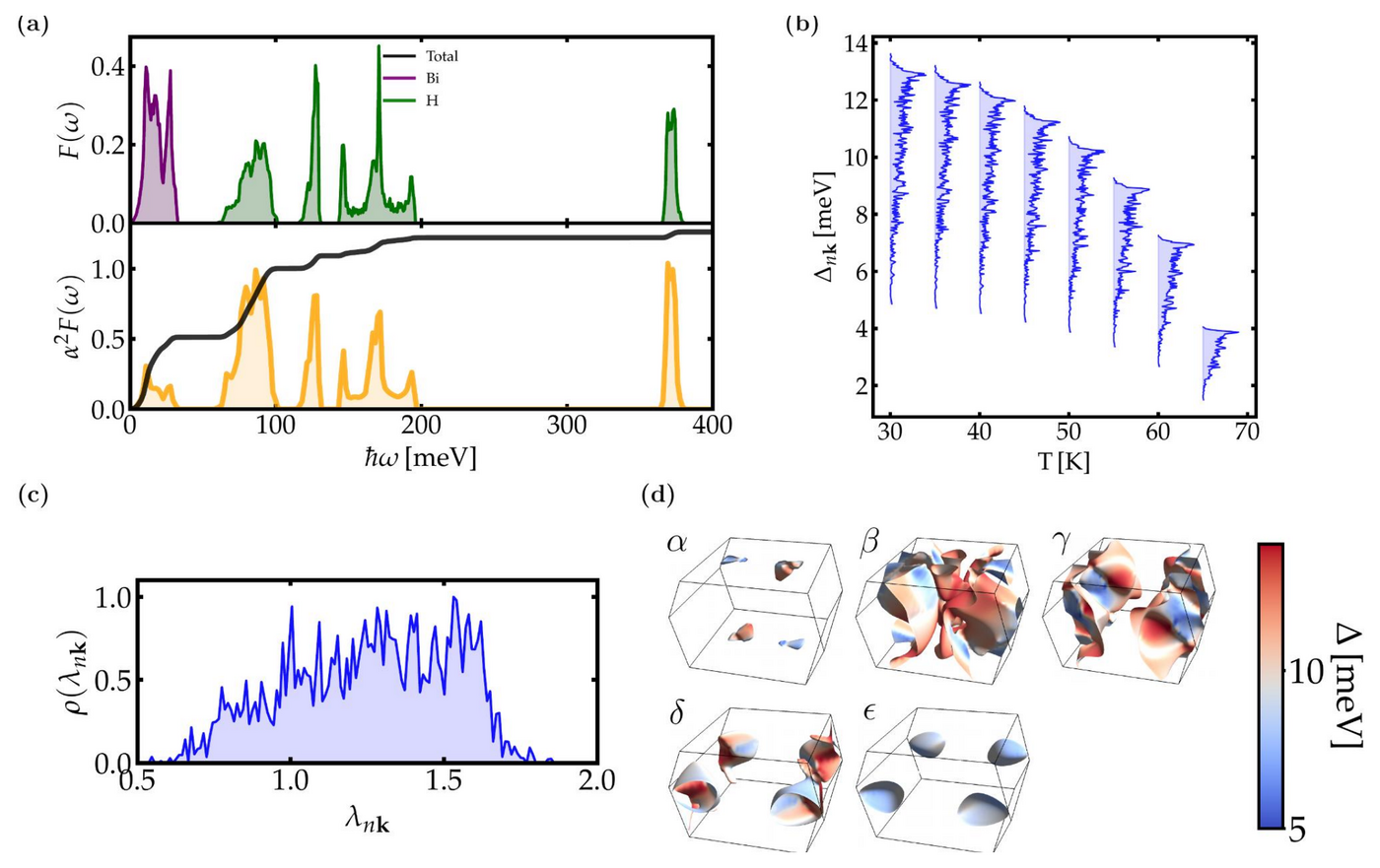
Fitting the measured Jc(T), reproducible across two runs a month apart, works poorly with a single s-wave or a d-wave gap and well with a two-scale s-wave form, yielding effective energy scales of about 6.9 and 1.5 meV. That looks like a clean two-gap superconductor, and given that bismuth and hydrogen phonons are separated by a factor of five to six in frequency, a two-gap scenario is not at all implausible. Our contribution was to test it directly: we solved the fully anisotropic Migdal-Eliashberg equations for P21/m-BiH2 at 176 GPa using maximally localized Wannier functions in EPW, obtaining λ = 1.26 and ωlog = 44 meV.
The calculated gap distribution tells a different story. Instead of two well-separated peaks, as one finds in MgB2, Δnk forms one broad continuous distribution spanning roughly 5 to 14 meV at 30 K, mirroring an equally broad spread of the coupling strength λnk between 0.5 and 1.9, and closing at about 67 K in good agreement with experiment. Five sheets cross the Fermi level; the ε sheet does carry smaller gaps, but it holds too little spectral weight to constitute a second band in any meaningful sense. The situation closely parallels NbSe2, where overlapping distributions from a single strongly anisotropic gap produce two-shoulder spectra that look convincingly like two order parameters. We therefore read the two-gap fit as a signature of gap anisotropy rather than of two independent gaps, a caution that applies to any indirect probe sensitive to a Fermi-surface average.
Taken together, the work establishes pulsed critical-current measurements as a practical, gap-sensitive transport probe under extreme pressure, one that needs no dedicated junction and fits a conventional DAC configuration. With further increases in peak-current capability, the same approach should become applicable to the room-temperature candidates such as La-Sc-H.
We’re excited to share this work and look forward to the community’s feedback!
Check out the preprint arXiv:2505.12062.