Two New Papers Published in ACS Journals
High-pressure synthesis reveals superconducting lithium compounds and novel lanthanum hydrides
We are delighted to announce the publication of two exciting papers from our collaboration with experimental groups, both exploring novel materials under extreme pressure conditions.
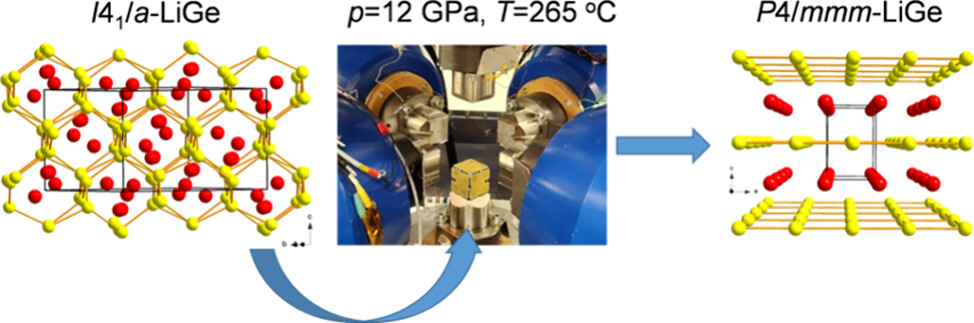
Superconducting LiSi and LiGe with Square Planar Nets
The paper Superconducting high pressure forms of LiSi and LiGe featuring square planar nets, published in Chemistry of Materials, reports the synthesis of novel P4/mmm phases of lithium-silicon and lithium-germanium at ~12.5 GPa. These structures feature unusual square planar nets of Si or Ge atoms—a rare geometry for group IV elements. P4/mmm-LiGe can be recovered to ambient pressure as a metastable phase and exhibits superconductivity with a critical temperature of 6.3 K, confirmed by magnetic susceptibility measurements. Our first-principles calculations predict similar behavior for LiSi (~6 K) and reveal that superconductivity originates from electron-phonon coupling in the square planar nets, representing a fundamentally different bonding motif than the three-bonded networks found in ambient-pressure phases.
Investigation of La-Al-H and La-Si-H Systems at High Pressures
The second paper Investigation of the La-Al-H and La-Si-H systems at high pressures, published in Inorganic Chemistry, systematically explores lanthanum hydrides at pressures up to 20 GPa. We report the successfull synthesization of LaAlH6 with rhombohedral structure containing octahedral [AlH6]-3 units at remarkably low pressures (~2 GPa), much lower than initially predicted. Crystal structure prediction reveals that the La-Si-H system can form diverse hydrides: interstitial LaSiH at ambient pressure, and at 20 GPa both LaSiH2 (predicted Tc ~10 K) and the semiconducting hydridosilicate LaSiH₇ with hypervalent [SiH6]2- complexes. While experiments provided evidence for LaSiH2 formation, higher pressures appear necessary to fully stabilize hydrogen-rich phases.
These studies demonstrate the power of high-pressure synthesis combined with advanced computational methods for discovering materials with exotic structures and promising electronic properties.