Paper published in Physical Review B
Quantum disorder engineering in superconducting Ti(O,N) thin films
We are excited to announce that our paper Quantum disorder engineering in superconducting Ti(O,N) thin films has been published in Physical Review B.
Titanium monoxide (TiO) and titanium nitride (TiN) are two closely related rock-salt superconductors that sit at opposite ends of a disorder spectrum: TiO is riddled with intrinsic vacancies and superconducts only below Tc ≈ 0.5 K, while clean TiN reaches Tc ≈ 6 K. Bridging the two, our experimental collaborators grew high-crystalline-quality titanium oxynitride Ti(O,N) films by nitric-oxide-assisted molecular beam epitaxy, using nitrogen substitution for oxygen as an anion-engineering knob to tune the material continuously between the oxide and the nitride.
The film with TiO0.6N0.4 stoichiometry superconducts at Tc ≈ 2.5 K, comfortably above pure TiO but well below TiN. Strikingly, the measured Tc as a function of anion ratio departs sharply from the trend expected from density-functional-theory and Eliashberg-equation calculations for the ideal ordered compounds—a clear sign that something beyond the average electronic structure is at play.
That something is disorder. Across the whole series, the normal-state resistivity follows the Mooij correlation, a hallmark of strongly disordered, amorphous-like metals. Our analysis shows that the disorder in TiO originates from stoichiometric titanium and oxygen vacancies, and that substituting more than about 10% nitrogen for oxygen suppresses vacancy formation while introducing only moderate chemical disorder on the anion sublattice.
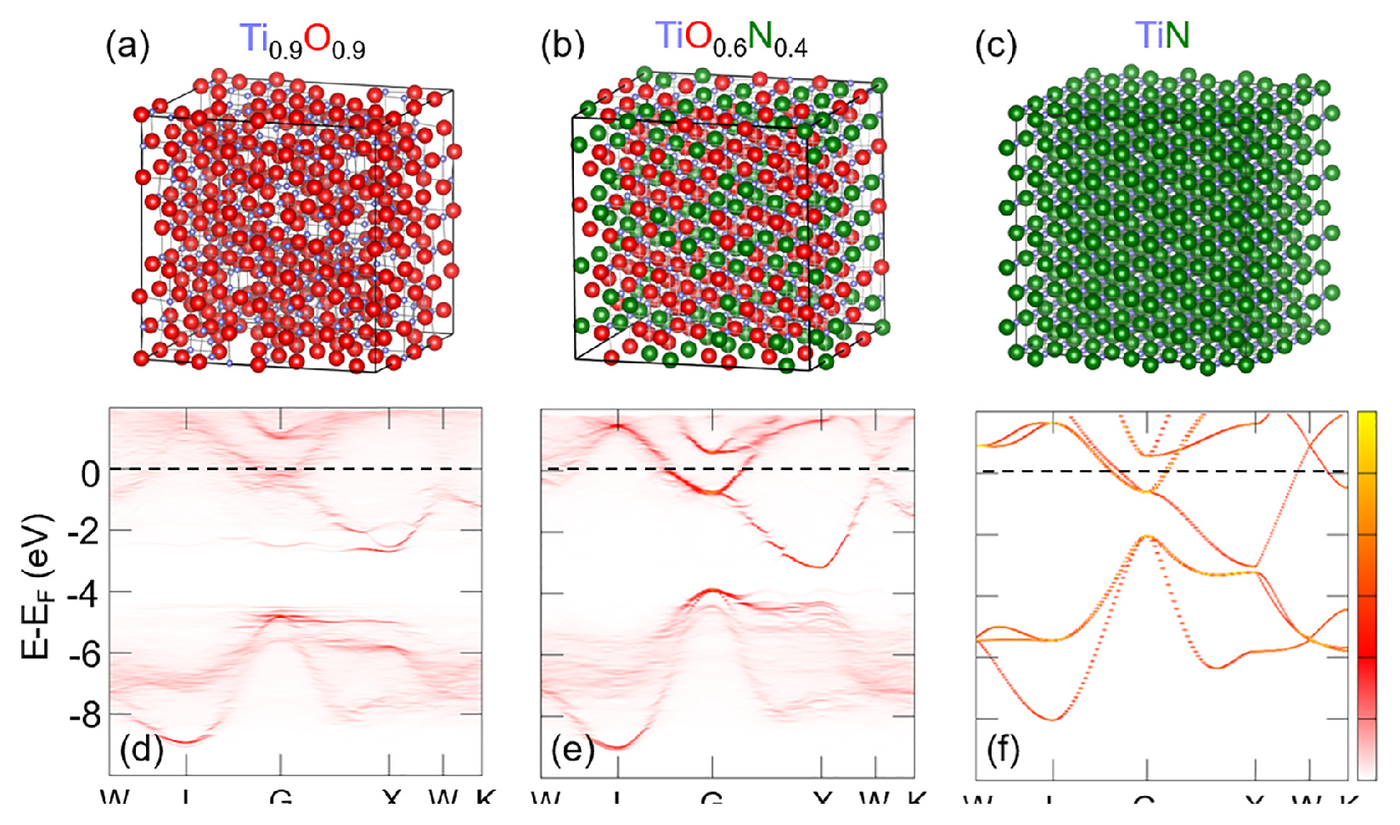
On the theory side, our first-principles calculations make the mechanism visible. Unfolding the electronic band structures of quasirandom supercells reveals how coherence is progressively destroyed: the spectral weight of vacancy-laden Ti0.9O0.9 is heavily washed out across the Brillouin zone, TiO0.6N0.4 sits at an intermediate level of incoherence, and stoichiometric TiN retains sharp, coherent bands. Anion chemistry thus provides a direct handle on the quantum coherence of the Cooper pairs, establishing titanium oxynitrides as a clean model system in which stoichiometry, disorder, and superconductivity can be dialed in by design.
Read the full paper at doi.org/10.1103/cjgd-fjh2.