Paper published in PNAS
The path to room-temperature superconductivity - A programmatic approach
We are pleased to share that our Perspective article The path to room-temperature superconductivity: A programmatic approach has been published in PNAS.
Room-temperature superconductivity remains one of the central open problems in condensed-matter physics. In this article, we argue that there is no fundamental physical law forbidding superconductivity at ambient temperature, and we outline a coordinated research strategy for making systematic progress toward that goal.
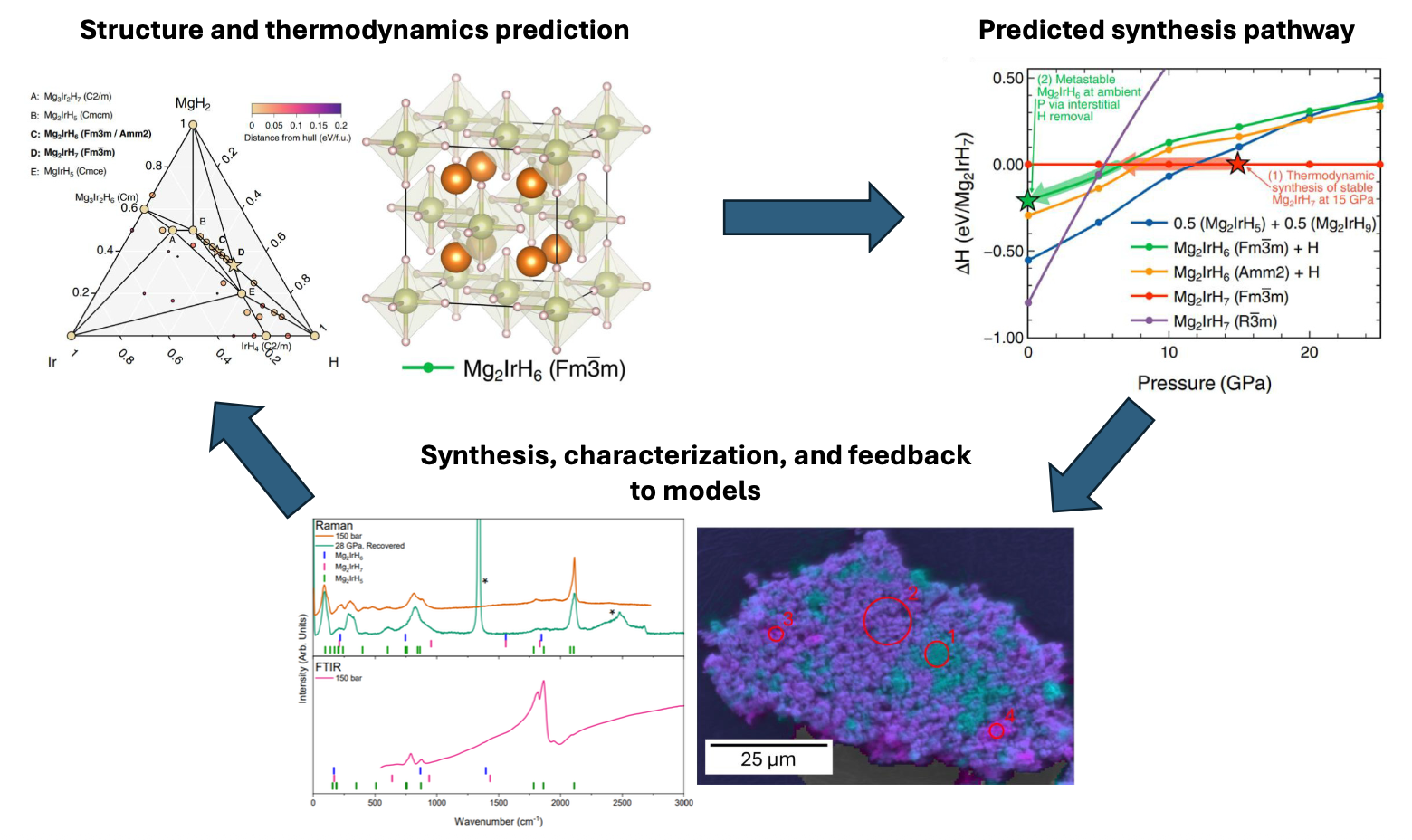
The paper identifies two grand challenges. The first is the Prediction Challenge: although first-principles methods for superconductivity have advanced rapidly, many theoretically promising compounds remain difficult or impossible to synthesize in practice. We therefore argue that the field should move beyond predicting critical temperatures alone and place greater emphasis on predictive thermodynamics, synthesis modeling, and high-throughput computational screening of experimentally realizable materials.
The second is the Engineering Challenge: superconductivity can be modified and enhanced by external and structural tuning knobs such as pressure, nanostructuring, and light, but our ability to predict and control these effects is still limited. We discuss how such knobs can be used to design and optimize superconducting states more deliberately, including through the broader concept of quantum metamaterials.
A central message of the article is that progress will require theory and experiment to be linked in a tight feedback loop. Modern ab initio simulations, realistic materials modeling, machine learning, and data-driven approaches now make it possible to explore the vast space of candidate materials and tuning strategies much more efficiently than before.
Recent experimental advances underline why this is a timely moment for the field. As highlighted in the related coverage of the paper, a companion study in the same issue reports pressure-quenched Hg-1223 with superconducting transition temperatures of up to 151 K at ambient pressure, illustrating how engineered pathways may open new routes toward higher-temperature superconductivity.
This publication is a call for a coordinated, interdisciplinary effort across physics, chemistry, and materials science to move the search from isolated breakthroughs toward a more systematic program.
Read the full article at doi.org/10.1073/pnas.2520324123.
The paper was also featured in the news, including by Phys.org and APA Science.