Paper published in Physical Review B
Anharmonic lattice dynamics and superconductivity in strained bulk and surface niobium
We are excited to announce that our paper Anharmonic lattice dynamics and superconductivity in strained bulk and surface niobium has been published in Physical Review B.
Niobium is the workhorse of superconducting technology, from radio-frequency cavities in particle accelerators to superconducting qubits and single-photon detectors. In this now peer-reviewed work, led by Mihir Sahoo, we ask how two handles that are present in every real Nb device, strain and crystallographic surface orientation, shape Tc at the microscopic level. To answer this, we combine first-principles electron–phonon calculations with isotropic Migdal–Eliashberg theory.
For bulk Nb, tensile strain softens the phonon spectrum and strengthens the electron–phonon coupling: within the harmonic approximation, Tc rises from 9.5 K at equilibrium to 14.6 K at 6% lattice expansion. During the review process we went one step further and included anharmonic lattice effects for strained bulk Nb as well. They are small near equilibrium but grow under tensile strain and considerably reduce the enhancement at large expansion, while a moderate increase of Tc survives at intermediate strain.
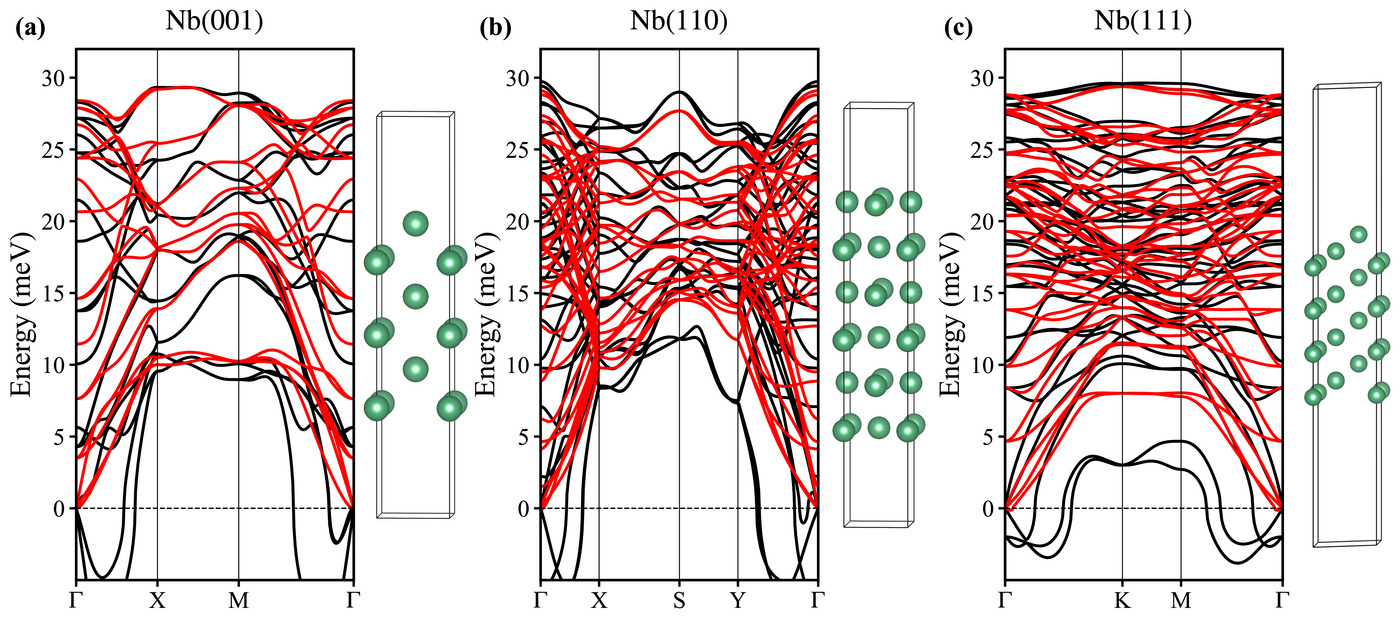
At the surface, anharmonicity is not a correction but a necessity: harmonic phonon calculations for the Nb(001), Nb(110), and Nb(111) slabs all show imaginary modes (black lines in the figure below). Using Nb-specific machine-learning interatomic potentials to accelerate stochastic self-consistent harmonic approximation (SSCHA) calculations, we obtain fully stabilized phonon spectra (red lines) and find a clear orientation dependence: Nb(001) has the strongest coupling (λ = 1.06) and the highest Tc of 10.1 K, followed by Nb(110) with 7.8 K and Nb(111) with 6.2 K.
The final version also looks more closely at where this coupling comes from. Resolving it layer by layer shows that the outermost atomic layers carry the soft, anharmonically renormalized modes and couple more strongly than the interior of the slab. Thicker slabs approach the bulk value from opposite sides while keeping the ordering of the terminations, so the size of the orientation effect is characteristic of the ultrathin regime. In-plane epitaxial strain on Nb(001), finally, acts opposite to bulk strain: compression raises Tc to 14.0 K, while tension suppresses it.
Across all of these cases, the functional derivative δTc/δα2F(ω) gives a unified, energy-resolved picture: where the electron–phonon coupling sits in the phonon spectrum matters as much as how strong it is. Strain, surface termination, and anharmonic phonon renormalization thus act as coupled microscopic routes for tuning superconductivity in Nb, which is directly relevant for superconducting cavities and quantum devices, where surface preparation, crystallographic quality, and residual strain are key experimental handles.
The paper is open access. Read it at doi.org/10.1103/tn2d-vjy1.